

Cleared Doesn’t Mean Ready to Train or Play
You were cleared. You went back. And something still feels off.
That gap confuses people. They were told the injury healed. The scan looked fine. The visit ended with a green light. Then they returned to training or their sport, and the body did not cooperate the way they expected.
If that's your situation, I want to say this clearly. You're not imagining it. Cleared and ready are two different things, and they answer two different questions.
Cleared and ready are not the same question
Clearance answers a narrow and important question. Is the tissue healed enough to be safe? Has the fracture knit, the sprain calmed, the surgical repair stabilized? That's a real medical judgment, and the providers who make it are doing their job.
Readiness answers a different question. Can your movement system handle the load you're about to put on it? Can the joint accept force, the muscle produce it on time, the pattern hold up under fatigue and speed?
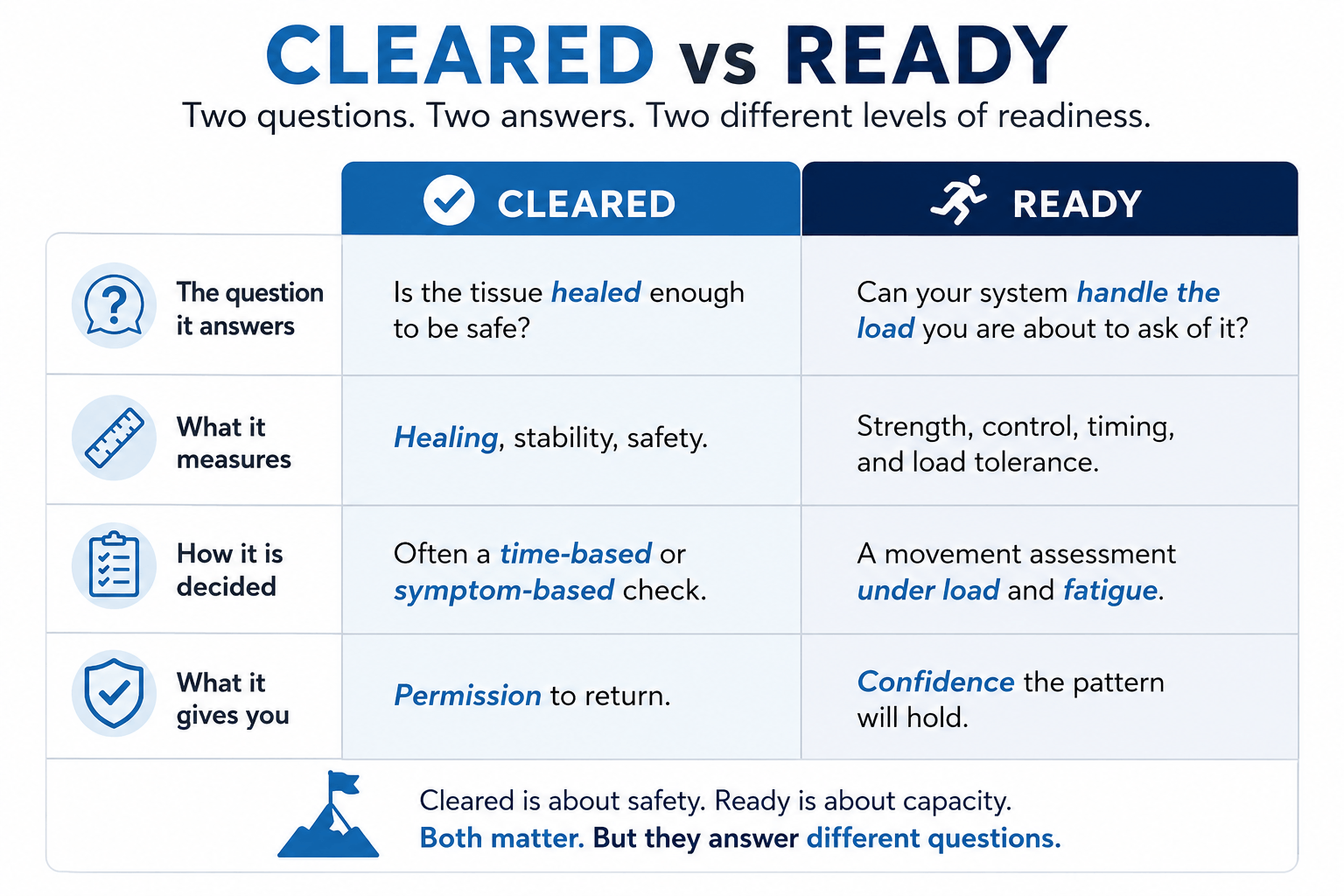
Those questions live in different places. One is about safety. The other is about capacity. You can pass the first and still fall short on the second.
Not because anyone made a mistake. Because the two questions were never the same.
What the research actually shows
The clearest data on this comes from one of the most studied injuries in sports medicine, the ACL. The pattern it reveals reaches far beyond the knee.
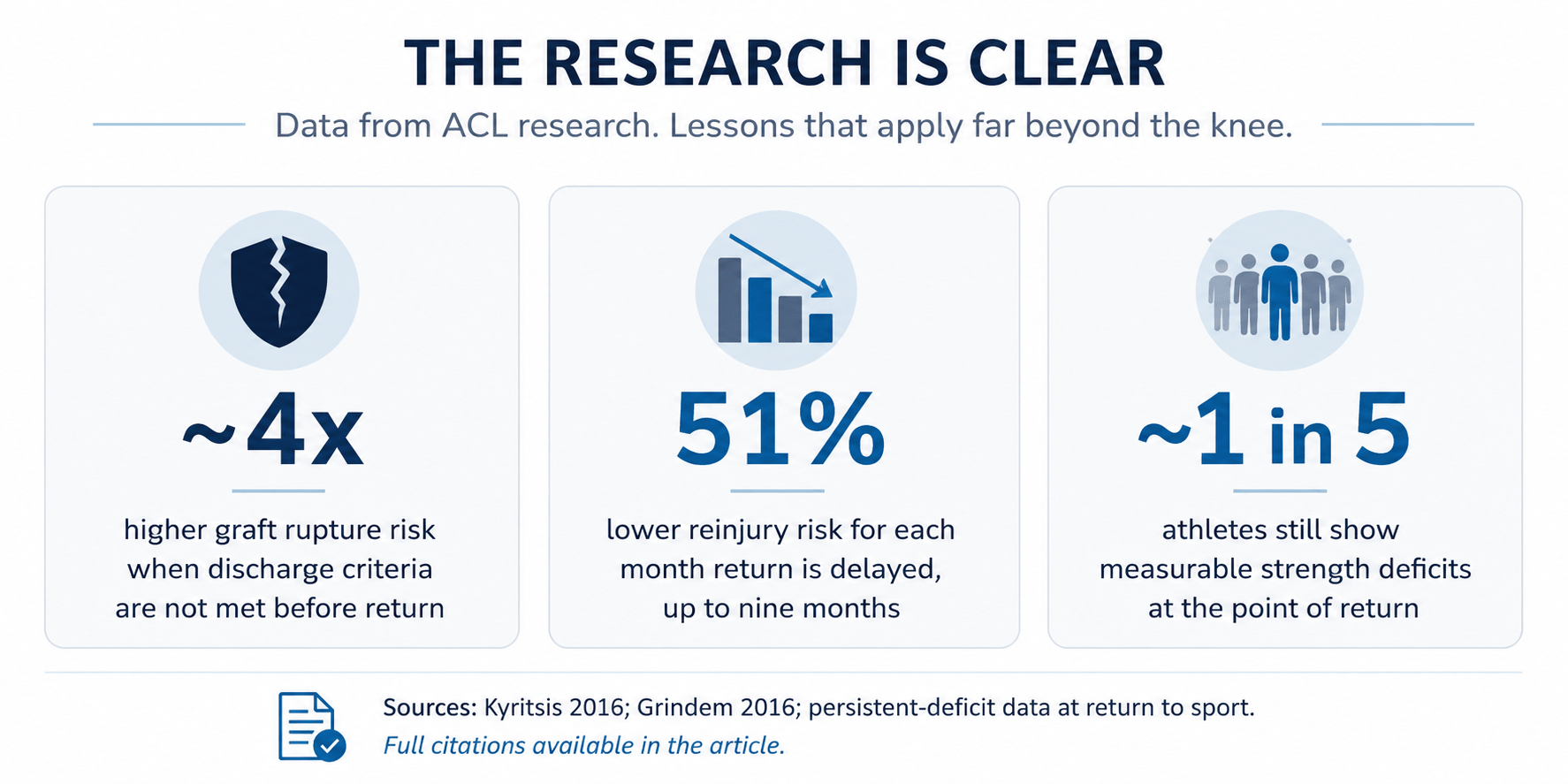
Athletes who return to pivoting sport early carry a much higher reinjury rate, and the risk drops sharply when return is delayed and side-to-side strength is restored first. In one well-known cohort, each month of delayed return up to nine months cut reinjury risk by roughly half, and more symmetrical quadriceps strength meaningfully lowered it (Grindem et al., 2016).
A separate study found that athletes who had not met established discharge criteria before returning carried about four times the graft rupture risk of those who had (Kyritsis et al., 2016).
Here's the part most people never hear. A meaningful share of athletes, close to one in five, still show measurable strength deficits at the moment they return to play (Sherman et al., 2023).
There's also no single agreed-upon standard for what return testing should even include, which is why “cleared” can mean very different things depending on who performed the check (Losciale et al., 2019).
Read those together and the message is calm and consistent. Clearance is real. Readiness is measurable. And the two do not always arrive on the same day.
The structural side: capacity is built, not granted
Here's what I look at after two decades of working with active people. A joint can be stable and still be under-prepared. Stability is the floor. Capacity is the ceiling.
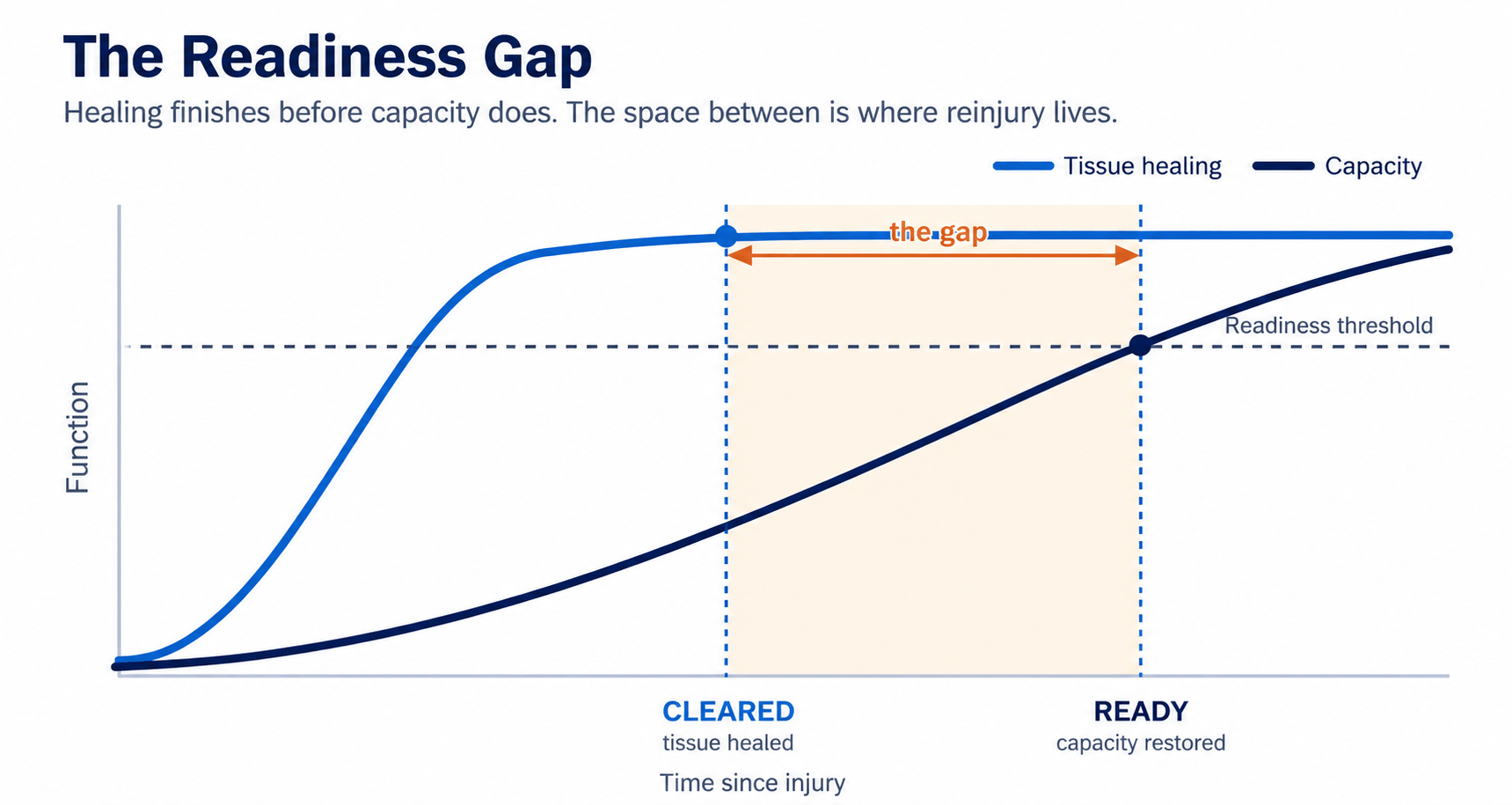
When an injury heals, the tissue closes. That does not automatically restore the strength, the control, or the timing the area had before. Those have to be rebuilt. They do not return on their own just because the pain left.
So the body does what bodies do. It compensates. It borrows from the joint above or below, shifts load onto patterns that were never designed to carry it, and lets you move well enough to pass a casual check. It feels like progress. It is actually a workaround.
That workaround is quiet. You don't notice it on an easy day. You notice it when you add speed, volume, or fatigue, and the borrowed pattern runs out of room. That flare is not random. It's the system telling you capacity never caught up to clearance.
The recovery-capacity side
There is one more layer, and it sits underneath the mechanics.
Tissue heals at the rate your whole system allows. Sleep, total recovery load, and the body’s overall ability to repair all shape how fast and how completely a structure rebuilds. Two people with the same injury and the same timeline can arrive at very different levels of readiness, because their recovery capacity was not the same.
This is why a timeline alone is a poor measure of readiness. The calendar treats everyone identically. Your physiology does not.
Learn more about the Performance Gap
This is something we see often
The story repeats almost word for word. A patient was hurt, did the rehab, felt better, and got cleared. They returned at the same load they left at. Within weeks, the same area or a nearby one started complaining again.
They come in believing they're fragile, or that they did something wrong. Neither is true. They were cleared on healing and returned on assumption, and the readiness gap was never closed.
That's not a character flaw. It's data. And data is something we can work with.
What commonly gets missed
The missed step is rarely the treatment. It's the reassessment.
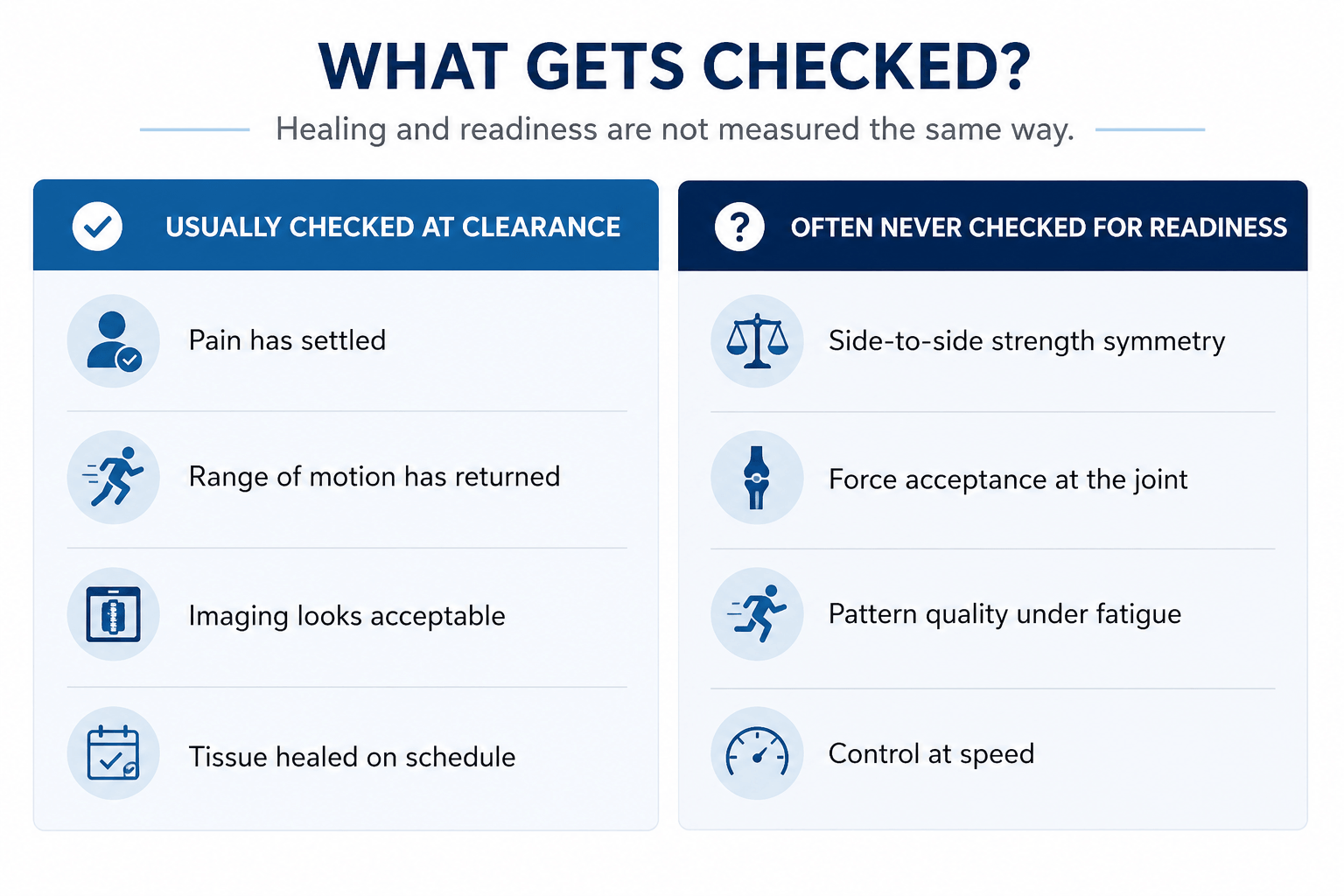
Most people are never tested for readiness the way they were tested for healing. No one watched them move under load. No one measured side-to-side strength, checked how the pattern held under fatigue, or confirmed the joint could accept force and not just tolerate rest.
When that check is skipped, clearance becomes the finish line by default. The body returns to full demand carrying a deficit nobody named.
What actually needs to change
The change is not more effort. It's the right assessment at the right moment.
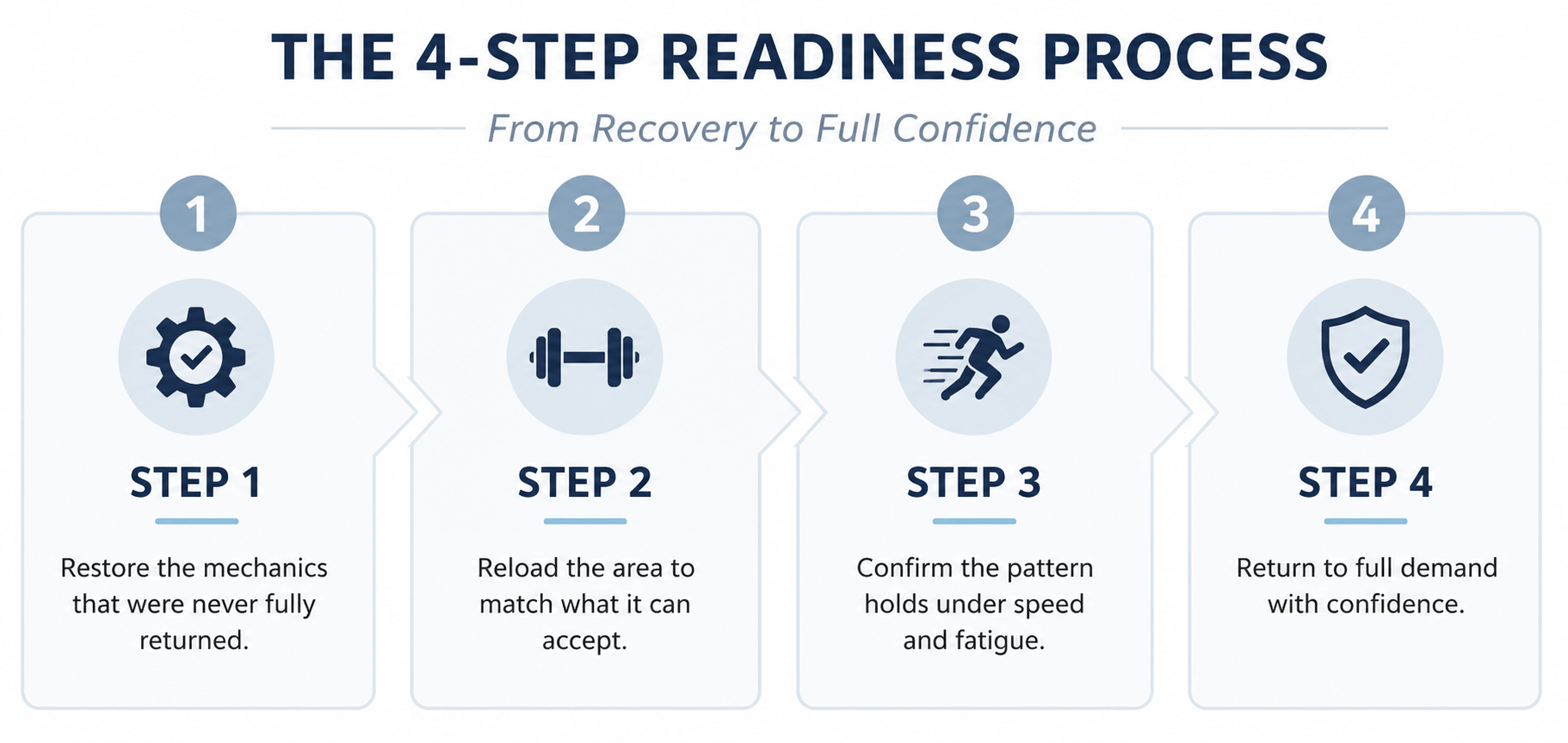
Readiness is restored by rebuilding capacity in the order the body uses it. Restore the mechanics that were never fully returned. Reload the area to match what it can accept, not what the calendar says it should. Confirm the pattern holds under speed and fatigue before trusting it with full demand.
That sequence is what closes the gap between cleared and ready. It is also what keeps the same injury from cycling back a third and fourth time.
Key takeaways
Clearance answers whether tissue is healed and safe. Readiness answers the question of whether your system can handle load. They are different questions.
Healing does not automatically restore strength, control, or timing. Those are rebuilt, not granted.
Returning before capacity is restored raises reinjury risk, and measurable deficits are common at the point of clearance.
A timeline is a poor measure of readiness, because recovery capacity differs from person to person.
The missing step is usually reassessment, not more treatment.
If this sounds like you
If you were cleared and still do not feel ready, that gap is worth taking seriously. Not with alarm. With a closer look.
A Failed Injury Recovery Evaluation is built to find what clearance did not measure. We look at how the area moves under load, where capacity fell short, and what needs to be rebuilt before you trust it at full demand.
If you're done accepting “you’re cleared” as an answer when it doesn't match how you feel, that's where we start.
References
Grindem H, Snyder-Mackler L, Moksnes H, Engebretsen L, Risberg MA. Simple decision rules can reduce reinjury risk by 84% after ACL reconstruction: the Delaware-Oslo ACL cohort study. Br J Sports Med. 2016;50(13):804-808. PubMed
Kyritsis P, Bahr R, Landreau P, Miladi R, Witvrouw E. Not meeting six clinical discharge criteria before return to sport is associated with a four times greater risk of ACL graft rupture. Br J Sports Med. 2016;50(15):946-951. PubMed
Losciale JM, Zdeb RM, Ledbetter L, Reiman MP, Sell TC. The association between passing return-to-sport criteria and second ACL injury risk: a systematic review with meta-analysis. J Orthop Sports Phys Ther. 2019;49(2):43-54. PubMed
Persistent quadriceps strength deficits after ACL reconstruction at return to sport. National Library of Medicine (PMC). PMC