
The Joint That Was Never Fully Restored
You were told the injury healed. The imaging looked fine. You were cleared. And yet something still is not right.
If that is where you're sitting right now, I want to offer a different explanation than the one you've probably been given.
Your recovery did not stall because you failed to do the work. It stalled because one joint was never fully restored, and your body has been building around that gap ever since.
That is not a character flaw. It's mechanics.
When healed and restored are not the same thing
Here's the distinction almost no one draws for you.
Healing is what tissue does. A muscle knits. A ligament settles. Inflammation resolves. On a timeline, that part often finishes on schedule.
Restoration is different. Restoration is when a joint moves the way it is supposed to move again. Full range. Clean mechanics. Confident under load.
A joint can be pain free and still be restricted. It can look normal on a scan and still be moving poorly. Those two things live in completely different lanes, and the gap between them is where most stalled recoveries actually live.
Your tissue healed. Your mechanics never got restored. That's the whole story in one sentence.
Why one joint can hold the whole system hostage
Your body doesn't work in isolated parts. It works as a chain.
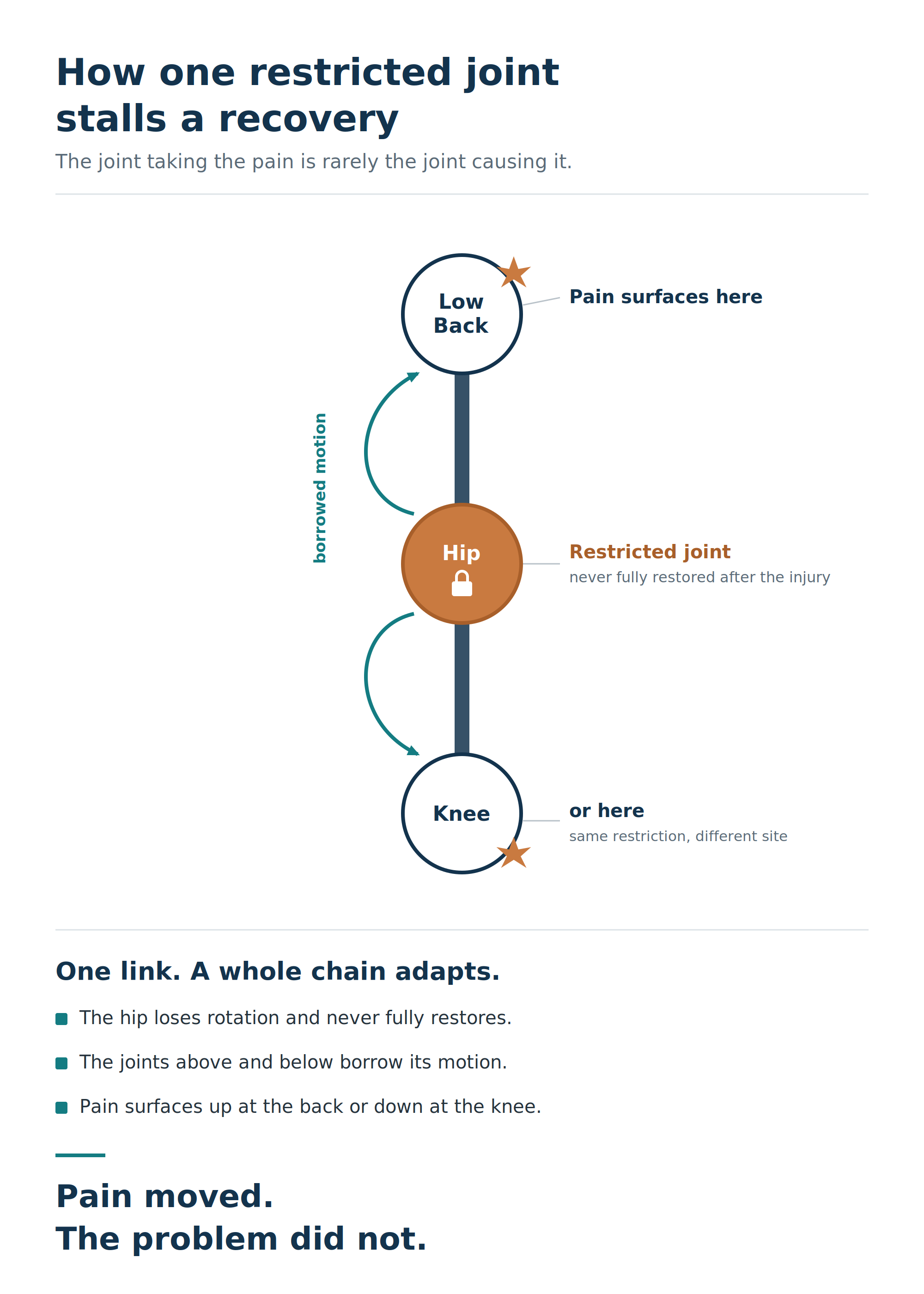
When one joint stops moving well, the joints above and below it do not wait around. They pick up the slack. They borrow the motion the restricted joint is no longer offering. In the short term, that feels like progress. You're moving again. You're training again.
But that borrowed motion has a cost. The joint doing the compensating was never designed to carry that load, in that direction, on repeat.
So the pain moves. It shows up a level up or a level down from the actual problem. And here's the part that catches people. You start chasing the pain, and the pain keeps relocating, because you're treating the site of the symptom instead of the source of the restriction.
Pain moved. The problem did not.
This is not a fringe idea. It has a name in the research. It's called regional interdependence, the principle that a complaint in one area is often driven by an impairment somewhere seemingly unrelated (Wainner et al., 2007). A later review laid out the mechanisms in detail, describing how dysfunction in one region shapes symptoms in another (Sueki et al., 2013).
What this looks like in real bodies
Let me make this concrete, because the pattern is remarkably consistent.
Take the ankle. When ankle dorsiflexion is limited, the body compensates up the chain. Research tracking lower extremity movement found that a stiff ankle shifts load into knee valgus, hip adduction, and internal rotation, which raises the odds of knee problems that have nothing structurally wrong with the knee itself (Wang et al., 2024). The knee hurts. The ankle is the reason.
Now the hip. Limited hip rotation is one of the most reliable quiet drivers of low back pain I see. In a study of elite hockey players, restricted hip rotation range predicted low back pain, because a hip that will not rotate forces the lumbar spine to rotate in its place (Cejudo et al., 2020). The back is where it hurts. The hip is where it started.
Different joints. Same story.
The joint taking the pain is rarely the joint causing it.
The pattern we see often
This is something we see week after week in the clinic.
Someone comes in months, sometimes years, after an injury that was supposedly resolved. They did the rehab. They followed instructions. They're diligent people. And they're frustrated, because diligence was supposed to be enough.
When we actually watch them move and assess the individual joints, we find it. One segment that never got its motion back. Everything downstream has been quietly reorganizing around it.
The compensation was so smooth that no one flagged it. That's exactly why it was missed.
What commonly gets missed
Most follow-up care checks whether you hurt. Fewer providers check whether you move.
Those aren't the same test. Pain resolving tells you the tissue calmed down. It tells you almost nothing about whether the joint restored its mechanics. You can pass the pain test and fail the movement test on the very same day.
An MRI will not catch this either. Imaging shows structure at rest. It doesn't show a joint under load, mid stride, doing its job. A joint can look pristine on film and still be moving poorly enough to stall your entire recovery.
So the restriction sits there. Invisible to the scan. Silent between flare ups. And it keeps feeding the compensation until the compensation itself becomes the new problem.
What actually needs to change
The fix is not more effort. It's a more accurate target.
The question stops being how do I make the pain stop, and becomes which joint never came back, and what's it forcing everything else to do. That's a mechanical question with a mechanical answer.
When you restore the restricted joint, the borrowed motion is no longer needed. The compensation unwinds. The pain that kept relocating loses its reason to exist, because the source is finally addressed instead of the symptom.
This is why reassessment matters more than repetition. You don't need to try harder at the plan that stalled. You need someone to find the joint the plan never restored.
Key takeaways
Healing and restoration are different. Tissue can heal while a joint stays restricted.
A restricted joint does not stay quiet. The joints around it borrow its motion and pay the price.
Pain often shows up a level away from the actual restriction, which is why chasing the pain fails.
Imaging and pain checks miss restricted mechanics, because neither one watches the joint move under load.
Restoring the one missed joint is what lets the rest of the system finally settle.
If this sounds like you
If you've been cleared but you still feel off, the next step is not another round of the same plan. It is finding the joint that was never fully restored.
That is exactly what a Failed Injury Recovery Evaluation is built to do. We watch you move, we assess the joints individually, and we locate the restriction that has been holding your recovery hostage.
If you are done guessing, this is where we start.
Spine Pain & Performance Center
References
1. Wainner RS, Whitman JM, Cleland JA, Flynn TW. Regional interdependence: a musculoskeletal examination model whose time has come. J Orthop Sports Phys Ther. 2007;37(11):658-660. https://pubmed.ncbi.nlm.nih.gov/18057674/
2. Sueki DG, Cleland JA, Wainner RS. A regional interdependence model of musculoskeletal dysfunction: research, mechanisms, and clinical implications. J Man Manip Ther. 2013;21(2):90-102. https://pubmed.ncbi.nlm.nih.gov/24421619/
3. Wang X, et al. The relationship of peak ankle dorsiflexion angle with lower extremity biomechanics during walking. 2024. https://www.ncbi.nlm.nih.gov/pmc/articles/PMC11296718/
4. Cejudo A, et al. External and total hip rotation ranges of motion predispose to low back pain in elite Spanish inline hockey players. Int J Environ Res Public Health. 2020;17(13):4858. https://www.ncbi.nlm.nih.gov/pmc/articles/PMC7369919/