
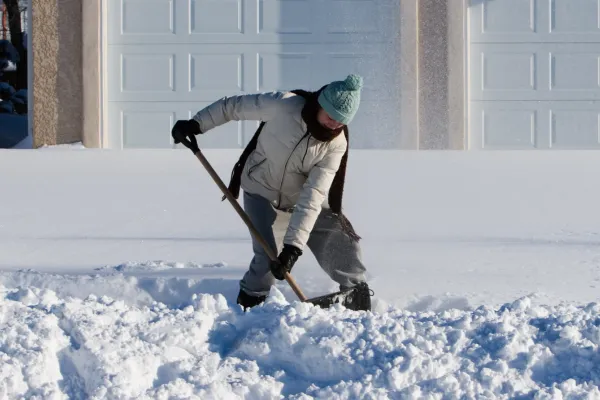
The Real Reason Your Back Fails When You Shovel Snow
"Your back does not fail because you lifted something heavy. It fails because the wrong tissues take the load at the wrong time."
Winter arrived early this year, and with it came back pain season. Maybe you stepped outside, shoveled for a few minutes, and felt that sharp sting in your lower back. Maybe it hit later that night when you bent over to take off your boots. Maybe it showed up the next morning when you tried to get out of bed.
Most people assume these moments happen out of nowhere. The truth is that they follow a very predictable mechanical pattern. The spine does not simply "go out." It loads, fatigues, and fails in specific ways. Understanding this is the key to staying pain free, especially during heavy snow weeks.
This article breaks down the actual biomechanics of why backs fail during shoveling, based on research from leading spine biomechanics experts, including Stuart McGill, peer reviewed studies on the flexion relaxation phenomenon, tissue loading, and injury mechanics.
Why So Many People Hurt Their Back When Shoveling
Shoveling seems simple, but it places a very complex stress pattern on the spine. Unlike controlled lifting in a gym, shoveling combines several risk factors at once:
Repetitive forward bending
Lifting weight far away from the body
Twisting while holding a load
Slippery conditions that create sudden slips and jolts
Cold muscles that are less prepared to absorb force
Flexion first thing in the morning when discs are more swollen
Data supports how significant this issue is. Research covering 17 years of emergency department data found that more than 11,500 snow shoveling injuries occur each year, with lower back pain accounting for over one third of them. These injuries are often diagnosed as low back strain, disc herniation, or sciatica.
Yet most of these issues come down to the same mechanical problem.
The Hidden Mechanic: The Flexion Relaxation Phenomenon
Your back has two types of tissues that handle load:
Muscles (your stabilizers and movers)
Passive tissues (your discs, ligaments, joint capsules, and fascia)
When the spine is at a safe, neutral angle, the muscles actively support your posture and protect the discs. But when you bend forward fully, something dramatic happens.
What the research shows
Studies using electromyography (EMG) reveal that when the spine reaches full forward flexion, your stabilizing back muscles turn off. This is called the flexion relaxation phenomenon.
Once these muscles go quiet, the job of managing the load transfers to the passive tissues:
Interspinous ligaments
Supraspinous ligament
Posterior annulus of the disc
Facet joint capsules
These structures are not designed to handle repeated heavy loads, especially under cold conditions and fatigue.
This load transfer is the real reason so many people hurt their backs while doing simple tasks.
How Shoveling Overloads Your Passive Tissues
1. Repetitive flexion increases disc and ligament strain
McGill's tissue loading studies demonstrate that repeatedly bending the spine under load increases creep in ligaments and raises stress on the disc annulus. Over time the tissues weaken and lose their ability to recover between cycles.
In one well known spine biomechanics study, researchers found that fully flexed lumbar postures dramatically increase passive tissue loading, especially in the interspinous and supraspinous ligaments. In fact, ligament forces can exceed several hundred newtons when the spine is fully bent.
2. Flexion plus shear is the dangerous combination
Shoveling creates forward bending plus a forward shear force at the lower lumbar segments. Research shows that:
The lumbar spine tolerates more than 10,000 N of compression
It tolerates only about 2,000 N of anterior shear
Shoveling repeatedly produces flexion shear loads that get close to this limit, especially during twisting or when a person loses balance.
3. Slips and sudden jolts create ballistic loading
One study showed that the rate of loading matters as much as the amount of load. When someone slips on ice, the trunk flexes suddenly and the spine experiences a fast spike in shear load. This is when disc fibers tear.
Why Morning Shoveling is Especially Risky
Spinal discs are more hydrated and swollen in the morning. This increases bending stress on the annulus and lowers the tolerance for flexion loads. Research confirms that early morning full flexion is one of the most dangerous movements for the low back.
Combine that with heavy snow and cold muscles and you get the perfect storm for injury.
The Moment Your Back "Gives Out"
People often describe the moment as:
A sharp pinch when standing up
A pop followed by pain
Pain down the leg
Tightness with walking or bending
This usually means that the spine hit its threshold for passive tissue loading. Sometimes the injury is minor inflammation. Sometimes it is a disc bulge. Sometimes it is an annular tear.
The good news is that these are mechanical problems, and mechanical problems respond well to mechanical evaluation and correction.
How to Protect Your Back When Shoveling
Step 1: Keep your spine neutral
The neutral spine position keeps the load on the muscles, not the ligaments. This is the safest and most efficient way to shovel.
Step 2: Use a hip hinge
Push the hips back like you would during a deadlift. This protects the lumbar spine and allows the glutes and hamstrings to assist.
Step 3: Move your feet instead of twisting
Twisting under load is a major cause of annular damage in the disc. Pivot with your feet to face the direction you are throwing snow.
Step 4: Brace before you lift
A light abdominal brace activates the stabilizers and helps prevent shear.
Step 5: Take smaller loads
Studies show that the further weight is held from the body, the higher the shear force on the spine. Smaller scoops conserve your mechanics.
Step 6: Warm up for sixty to ninety seconds
A short warm up increases circulation, wakes up stabilizing muscles, and greatly reduces the shock of first lift.
When You Should Get Evaluated
Pain after shoveling is common, but not always normal. Red flags for evaluation include:
Pain with forward bending
Pain when putting on socks or shoes
Pain sitting or driving
Pain that travels into the buttock or leg
Sharp pain getting out of a chair
Increased pain with twisting or coughing
These symptoms often indicate disc involvement or ligament strain. The sooner a mechanical evaluation is done, the better the long term outcome.
How Spine Pain and Performance Center Helps
At SPPC we focus on correcting the exact mechanical pattern that created the injury. We do not guess. We identify:
The segment that is overloaded
The stabilizers that are turning off
The movement pattern that keeps provoking pain
Through precise Gonstead analysis, chiropractic adjustments, muscle-based therapies, and corrective movement strategies, we help restore normal loading to the spine.
Our approach is ideal for:
Busy professionals who need to stay active without flare-ups
Athletes who need reliable spinal mechanics for performance
Expecting mothers who need gentle and effective relief
Snow shoveling injuries are some of the most preventable conditions we see. With the right mechanics, your back can stay resilient all winter.
Special New Year Evaluation Option
If your back is stiff or painful from the recent snow, we are offering our December $79 New Patient Exam + X-Ray special. We are donating $50 to the Northern Illinois Food Bank to support families in our community during the colder months.
This visit includes:
A complete lumbar spine mechanical evaluation
Posture and movement analysis
Gonstead assessment to identify the exact segment involved
A personalized plan to restore normal function
FAQs
What makes shoveling so hard on the lower back
Shoveling combines forward bending, lifting weight away from the body, twisting, and sudden slips. This creates a pattern of flexion and shear that overloads the discs and ligaments. When the stabilizing back muscles shut off in full flexion, passive tissues take the load and can become injured.
Why does my back go out doing something simple like shoveling
Your back typically fails when passive tissues reach their limit. Even small loads can cause pain if the spine is repeatedly bent forward or twisted under tension. Shoveling exaggerates these movements and exposes weak points in the discs and ligaments.
Is it dangerous to shovel snow first thing in the morning
Morning is one of the highest risk times to shovel because spinal discs are more hydrated from sleep. This increases bending stress and lowers injury tolerance. A short warm-up and delaying shoveling if possible can reduce this risk.
How do I know if my shoveling injury is serious
Warning signs include pain bending forward, pain putting on socks, pain sitting or driving, sharp pain when standing up, or pain that radiates into the buttock or leg. These often indicate disc involvement and should be evaluated.
Should I use heat or ice after a shoveling-related back injury
Ice is generally better in the first twenty four to forty eight hours because it reduces inflammation in the joints and discs. Heat may feel good temporarily, but can increase swelling in irritated tissues. After the acute phase, alternating ice and heat can help.
Can chiropractic care help with shoveling injuries
Yes. A mechanical problem responds best to a mechanical solution. Chiropractic care can restore proper motion and alignment, reduce disc pressure, calm irritated nerves, and improve stability patterns so the injury heals correctly.
How can I prevent hurting my back next time
Keep the spine neutral, hinge at the hips, brace lightly before lifting, take smaller scoops, avoid twisting with load, and move your feet instead. Regular spine maintenance and strengthening your core stabilizers also reduces risk.
References
Below is a curated list of research and authoritative resources that support the biomechanics and injury mechanics discussed in this article.
Flexion Relaxation and Muscle Activity
Passive Tissue Loading and Lumbar Flexion Research
Shear Forces and Lumbar Injury Mechanics
Spinal Fatigue and Morning Vulnerability
Snow Shoveling Injuries and Emergency Data
Additional Patient-Friendly Resources
https://www.mayoclinic.org/healthy-lifestyle/adult-health/in-depth/snow-shoveling/art-20045187
https://www.ccohs.ca/oshanswers/ergonomics/snow_shoveling.html
https://www.health.harvard.edu/pain/6-tips-to-prevent-a-back-injury-while-shoveling-snow
https://www.spine-health.com/conditions/lower-back-pain/how-avoid-snow-shoveling-back-injury
Final Thought
You do not need to fear winter. You only need to understand how your spine actually handles load. When you protect the right structures, even heavy snow becomes manageable.