

Why Your Shoulder Keeps Coming Back
You have done the work on your shoulder. You rested it. You did the band exercises. Maybe you got an injection, or a round of treatment that calmed it down. It felt better. You went back to training. And within a few weeks, the same shoulder, in the same spot, was talking to you again.
If that sounds familiar, the problem is not that you did the rehab wrong. The problem is what the rehab was aimed at.
Here is what I want to say clearly after two decades of reading bodies under load. A shoulder that keeps coming back is rarely an isolated shoulder injury. It is the visible end of a pattern that starts somewhere else.
The shoulder is where the load concentrated. It's not where the problem began.
The shoulder isn't the problem. It's the result.
The Shoulder Is Built to Be Mobile, Not Stable
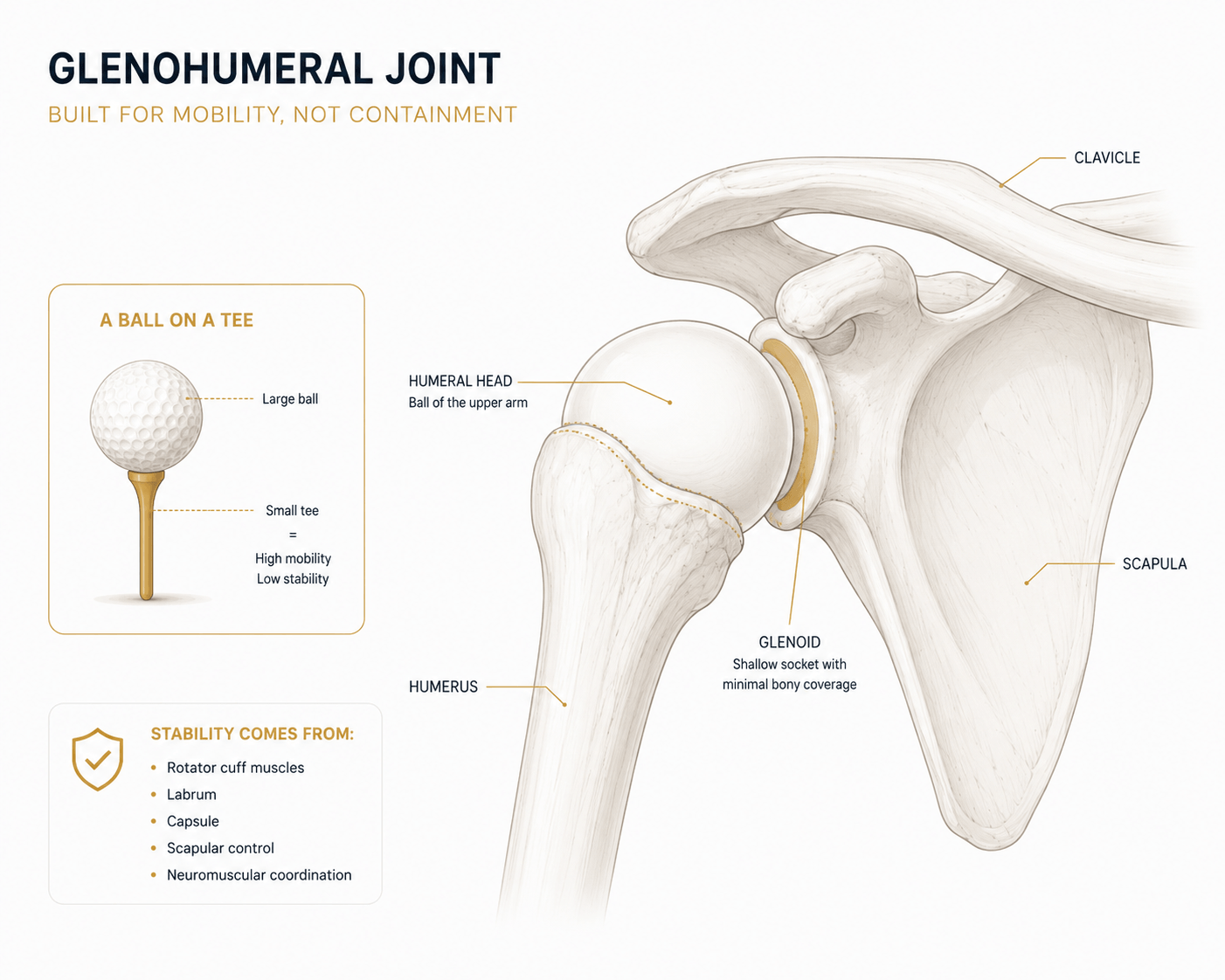
Of every major joint in the body, the shoulder gives up the most stability in exchange for range of motion. It has very little bony containment. A golf ball on a tee is the comparison people use, and it is accurate. That much mobility is what lets you reach, throw, press, and rotate. It is also what makes the shoulder completely dependent on the structures around it to give it a stable base and to share the load.
When that base is solid and the load is shared, the shoulder does its job for decades without complaint. When the base is unstable or the load is not shared, the shoulder absorbs the difference. It does that quietly, for a long time, until the tissue reaches its limit and the pain shows up.
The pain shows up at the shoulder. That does not mean the shoulder is the cause.
Where the Base Actually Comes From
The shoulder blade is the foundation the arm moves on. Its position and its control under load come from two places most shoulder treatment never looks at: the thoracic spine and the muscles that anchor the blade to it.
Your mid-back, the thoracic spine, has to extend and rotate for the arm to travel overhead cleanly. When the mid-back is stiff, which is common in anyone who sits for work or who has lost mobility since their athletic years, the shoulder has to make up the missing range. It does that by moving into positions it was not designed to load repeatedly.
The muscles that control the shoulder blade, the serratus anterior and the lower trapezius, set the timing. They position the base before the arm produces force. When their control is off, the base shifts late or shifts wrong, and the rotator cuff ends up working against a moving target.
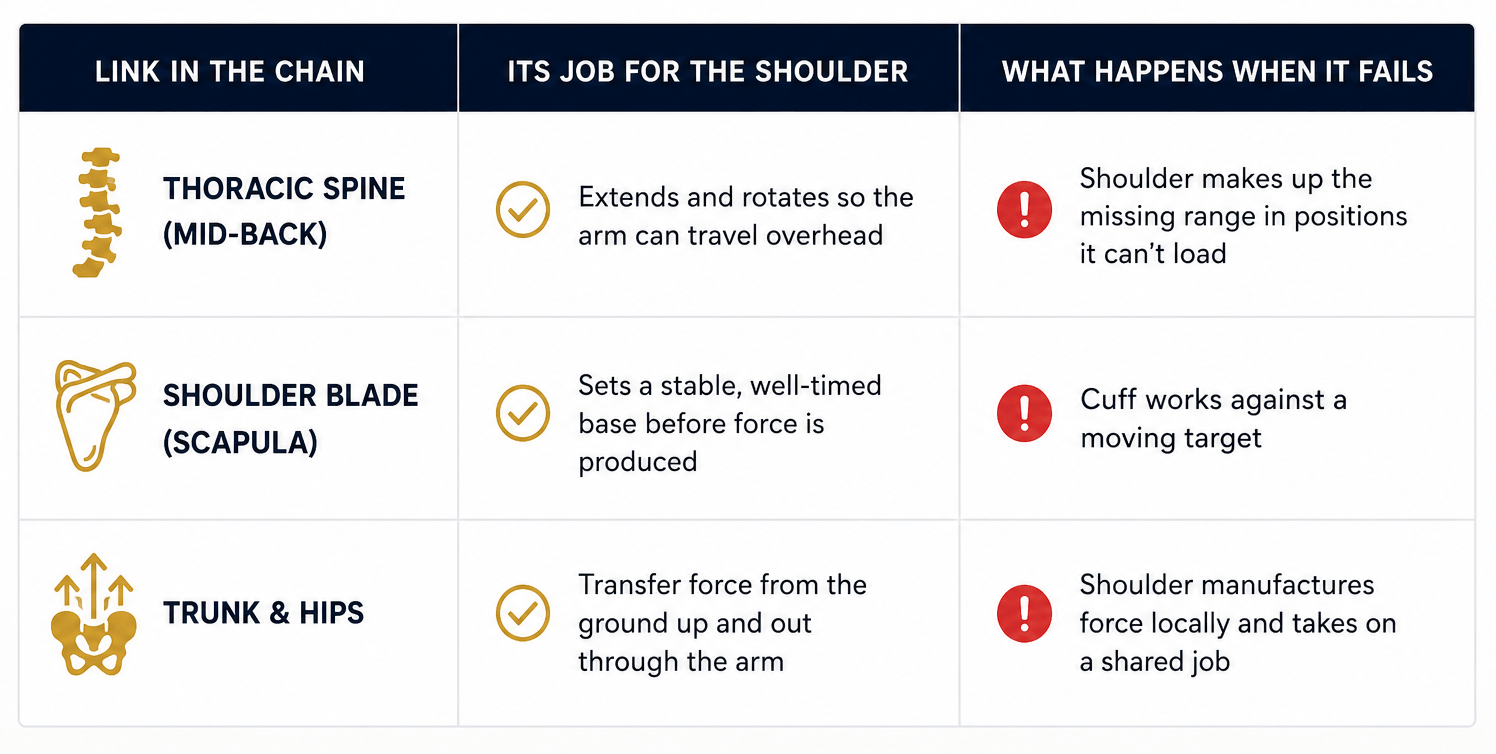
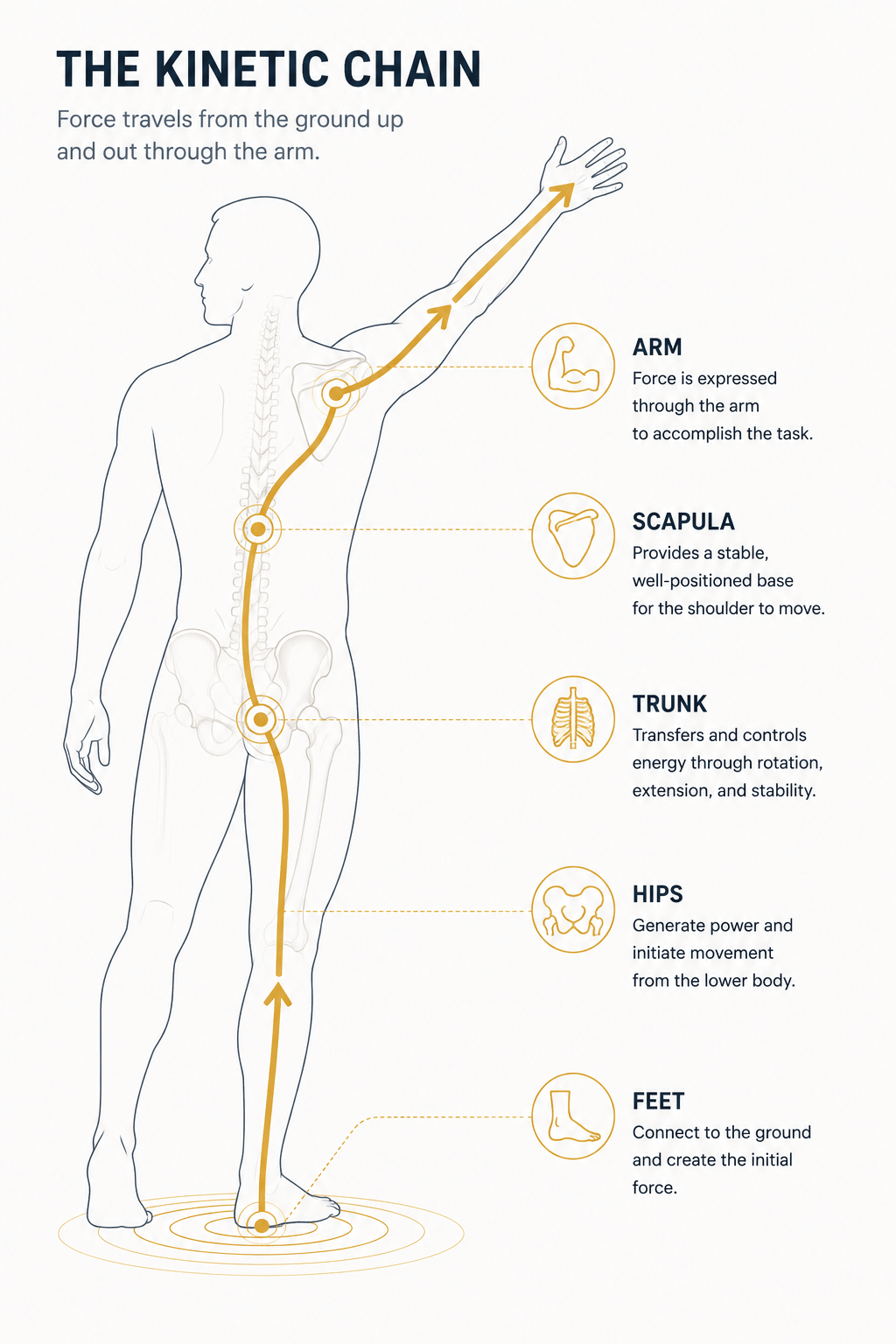
Now add the rest of the chain. Force in a press, a throw, or an overhead movement does not start at the shoulder. It transfers up from the ground, through the hips and the trunk, and out through the arm. When the lower body and trunk transfer force well, the shoulder delivers force it did not have to manufacture. When the chain below does not transfer, the shoulder produces that force locally. It takes on a job that was supposed to be distributed across the whole system.
This Is the Pattern We See Constantly
The patient is active. Often a former athlete who has come back to training after a few years away. The body remembers the movements. The press, the overhead work, the swing, the throw. What has changed is the support underneath those movements.
The mid-back is stiffer than it was at twenty-five. The scapular control has drifted. There may be an old asymmetry from a previous injury on the other side that the body has been working around for years. The movements demand the same load they always did. The structure that used to share that load is no longer doing its part.
So the shoulder covers the gap. It works. For a while. Then it flares. The athlete rests it, rehabs it, and the tissue calms down. They return to the same training, where the same gap is still there, and the shoulder takes the same load again. Same area. Same spot. Often the same timeline.
That is not bad luck and it is not a fragile shoulder. It is a load distribution problem that has never been addressed. The recurrence is the signal.
What Imaging Misses
When a recurring shoulder gets imaged, the scan usually finds something. Some fraying in the rotator cuff. A labral change. Wear in the AC joint. These findings feel like the answer.
The problem is that the same findings show up in large numbers of people who have no shoulder pain at all. The research on this is consistent. Structural changes on a shoulder MRI are common in pain-free shoulders, and their presence does not reliably explain why a particular shoulder hurts, or why it keeps coming back.
An image shows you the tissue. It does not show you the load that is reaching that tissue.
Treating the finding without reading the movement pattern that overloaded it is treating the result. The tissue calms down. The load that frayed it is still arriving. So it comes back.
What Actually Has to Change
A recurring shoulder needs two things, and most care only delivers one.
The first is local. The rotator cuff and the shoulder tissue do need attention, and good rehab matters. That part is usually not what is missing.
The second is the part that changes the trajectory. The driver has to be found and addressed. That means reading where the load is actually concentrating: thoracic mobility, scapular control under real load, how force transfers from the trunk and hips, and where in the chain the compensation begins. Restore the mid-back's ability to move. Restore the timing of the shoulder blade. Address the structural restriction that is forcing the shoulder to make up the difference. When the load distributes the way it was designed to, the shoulder stops absorbing what was never its job.
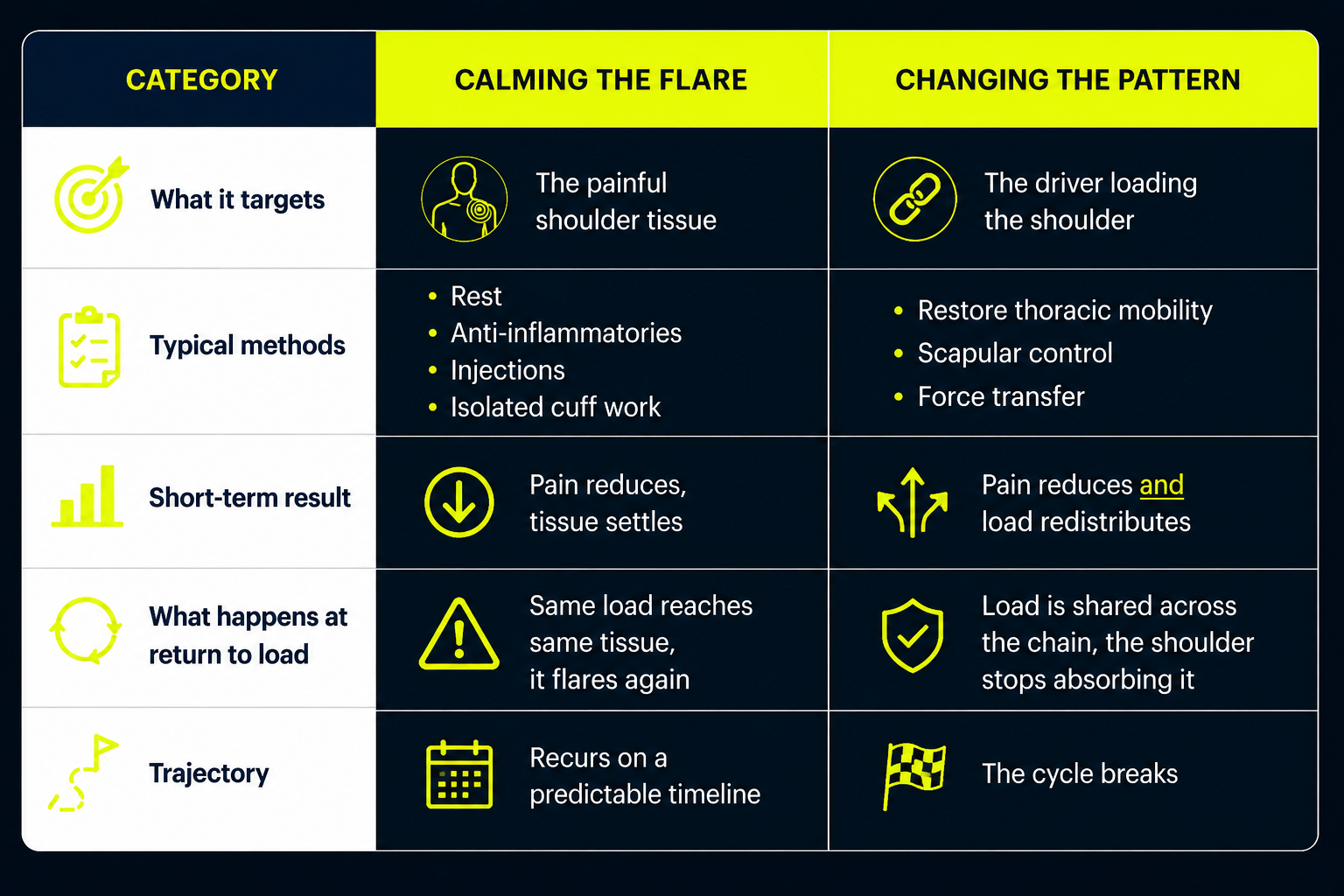
That is the difference between calming a flare and changing the pattern. One manages the symptom while the driver keeps operating. The other corrects the driver so the symptom stops being produced.
If your shoulder keeps coming back, you do not need to attack the shoulder harder. You need to find out what the shoulder has been compensating for.
A Movement Intelligence Assessment at Spine Pain and Performance Center reads the full chain, not just the site of pain. It locates where the load is concentrating and why the shoulder keeps absorbing it. That is where the cycle actually breaks.
KEY TAKEAWAYS
The shoulder trades stability for mobility, which makes it completely dependent on the structures around it for a stable base and shared load. When that support fails, the shoulder absorbs the difference until the tissue reaches its limit.
A shoulder that keeps coming back is usually a compensation pattern, not an isolated injury. The pain concentrates at the shoulder, but the driver is often the thoracic spine, scapular control, or force transfer from the trunk and hips.
The recurrence itself is the signal. If the same shoulder flares in the same spot after rehab and rest, the load that overloaded it was never changed.
Imaging commonly finds rotator cuff, labral, or AC joint changes that are also present in pain-free shoulders. A finding on a scan does not explain why a shoulder keeps coming back.
Lasting change requires both the local rehab and the correction of the upstream driver. Addressing the shoulder alone calms the flare. Addressing the load distribution changes the pattern.
REFERENCES
1. Kibler WB, Sciascia A. Current concepts: scapular dyskinesis. British Journal of Sports Medicine. 2010.
2. Sciascia A, Cromwell R. Kinetic chain rehabilitation: a theoretical framework. Rehabilitation Research and Practice. 2012.
3. Cools AM, et al. Rehabilitation of scapular dyskinesis: from the office worker to the elite overhead athlete. British Journal of Sports Medicine. 2014.
4. Sher JS, et al. Abnormal findings on magnetic resonance images of asymptomatic shoulders. Journal of Bone and Joint Surgery. 1995.
5. Lewis JS. Rotator cuff related shoulder pain: assessment, management and uncertainties. Manual Therapy. 2016.