
You've Been Treated. But Have You Ever Been Assessed?
If no one watched you move, something was missed
Most people who walk through our door have already done a lot.
They've been adjusted. They've seen physical therapists. They've done the stretches and the exercises and the heating pad routine. They've been told to rest. They've been told to strengthen. They've been told things are fine.
And yet something is still not right.
The pain comes back after a good week. The shoulder flares up after a hard workout. The hip tightens after a long day at the desk. They feel better for a stretch of time, and then something shifts and they're back where they started.
Here's what I want you to consider: it's not that the treatment failed. It's that the right question was never asked.
Treated vs. Assessed: A Critical Difference
There's a distinction I make with nearly every new patient, and it changes how the entire conversation goes.
Being treated means someone addressed your complaint. They worked on what hurt, stretched what was tight, adjusted what seemed off. That care may have provided real relief. But relief is not the same as resolution.
Being assessed means someone looked at how your entire system is moving, and more specifically, why it's compensating in the first place.
Most pain is not the starting point of a problem. It's a downstream signal. The area that hurts is usually the area absorbing the load from somewhere else. If no one evaluated the upstream cause, the downstream pain will return predictably.
What a Subluxation Actually Does
In the Gonstead system, we work from a foundational premise: when a vertebral segment loses its proper position and motion, what we call a subluxation, it does not just create local symptoms.
It creates a compensation pattern.
The body is an intelligent system. When one joint is restricted, altered, or mechanically compromised, the surrounding segments adjust. Muscles shift their recruitment. Joints above and below take on load they were not designed to carry. The nervous system continues trying to coordinate movement, but now it's working around an obstacle.
This is the body doing exactly what it's designed to do. It protects and adapts. But over time, that adaptation becomes the problem. The compensation itself starts generating pain, restriction, and dysfunction, often far removed from the original subluxation.
Research in movement science supports this. A 2009 study published in the Journal of Manipulative and Physiological Therapeutics found that spinal manipulative therapy produced measurable changes in neuromuscular activity, suggesting that joint dysfunction affects motor control well beyond the local segment. A 2015 review in the Journal of Electromyography and Kinesiology documented how altered joint mechanics in one region consistently produce compensatory muscle activation patterns throughout the kinetic chain. More recently, a 2017 study in Spine Journal examined how lumbar movement dysfunction propagates altered loading patterns into adjacent spinal segments over time.
This is not theoretical. This is what we see, assess, and address every week at Spine Pain and Performance Center.
Why the Gonstead Method Is Built Around This
The Gonstead method is one of the most specific and systematized approaches in chiropractic. Dr. Clarence Gonstead developed it because he understood something essential: adjusting the wrong segment is not just ineffective. It can reinforce the very compensation pattern you're trying to resolve.
So the Gonstead system does not start with where it hurts. It starts with a full-spine evaluation.
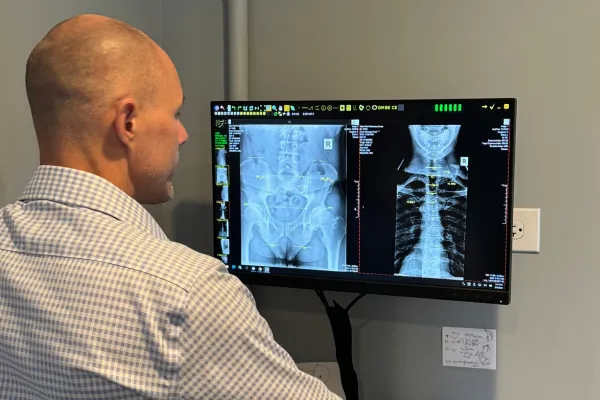
That means X-ray analysis to assess structural alignment and disc integrity. Instrumentation to detect thermal asymmetry along the spine, indicating where nerve function is altered. Static and motion palpation to identify where segments have lost their normal joint play. Visualization that includes posture, gait, and how the body loads and moves as a whole.
We are not looking for the loudest pain. We are looking for the primary subluxation, the one that started the compensation chain. Because that is the one that, when corrected precisely, allows the rest of the system to begin reorganizing.
Relief becomes possible. More importantly, resolution becomes possible.
The Pattern We See Most Often
A patient comes in with recurring lower back pain. They've had chiropractic care before. They felt better for a while, then the pain returned. They assume their back is just weak, or that they'll always have this problem.
When we run a full Gonstead evaluation, we often find the primary driver is not in the lumbar spine at all. There's a cervical or thoracic subluxation altering the neurological tone and postural load to the lower back. The lumbar spine was always compensating. It was never the source.
The previous care addressed the complaint accurately. It just did not address the cause.
This is not a criticism of what came before. Most assessment models are symptom-led. Gonstead is system-led. That difference determines everything about the outcome.
What This Means for You
If your pain keeps returning after treatment, after rest, after everything you've tried, the most important question to ask is not "What should I try next?" It's "Has anyone actually assessed how my body is moving and compensating as a whole?"
Because if the answer is no, then you have not run out of options. You have just never started with the right one.
An assessment that maps your compensation pattern, identifies the primary subluxation, and gives you a clear mechanical explanation is not a luxury. It is the prerequisite for care that actually resolves things.
Key Takeaways
Treatment addresses where it hurts. Assessment identifies why it keeps hurting.
Subluxations create compensation patterns throughout the entire spine and kinetic chain.
The Gonstead method uses a full-system evaluation, not a complaint-based one, to locate the primary cause.
If pain returns after care, the driver was likely upstream, not at the site of symptoms.
Precise assessment is what makes precise correction possible.
If this pattern sounds familiar, the next step is not more of the same. It is a Gonstead movement assessment that gives you a mechanical picture of what is actually happening and why.
Explore the Movement Intelligence Assessment at Spine Pain and Performance Center.
References
Dishman JD, Bulbulian R. Spinal reflex attenuation associated with spinal manipulation. Spine. 2000. https://pubmed.ncbi.nlm.nih.gov/10779314/
Haavik H, Murphy B. The role of spinal manipulation in addressing disordered sensorimotor integration and altered motor control. J Electromyogr Kinesiol. 2012. https://pubmed.ncbi.nlm.nih.gov/22902320/
Wong AY, Karppinen J, Samartzis D. Low back pain in older adults: risk factors, management options and future directions. Scoliosis Spinal Disord. 2017. https://pubmed.ncbi.nlm.nih.gov/28435906/
Pickar JG. Neurophysiological effects of spinal manipulation. Spine J. 2002. https://pubmed.ncbi.nlm.nih.gov/14589666/